Daniel Gumb: Work and Legacy
TL;DR
Daniel Gumb was a master stonemason who also taught himself advanced mathematics, astronomy, and cartography.
He turned his cave home into a classroom, carving mathematical proofs into the granite roof.
Despite living off-grid, he remained a respected professional – creating precise maps for local landowners and leaving behind defiant stonework that mocked the class system.
His self-taught genius made him indispensable to the very establishment he defied.
Professional Mastery: More Than Just a Mason
Stone Mason and Stone Cutter
Daniel’s profession was highly valued, especially with the abundant granite of Bodmin Moor literally under his feet.
Construction Projects: He shaped and prepared local stone for various construction projects including supplying granite for the regeneration of Liskeard Castle in 1749 and for a sundial for Trelaske House in 1760.
Church repairs: Between 1739 and 1746 the churchwarden’s accounts for Linkinhorne show some payments to Daniel Gumb, presumably for maintenance and repair work.
The ‘Signed’ Gravestone (Attitude Alert!): His most famous piece of decorative stonework is the finely engraved slate tombstone at St Melor’s Church. It includes a controversial, defiant epitaph that gives a rare insight into the class and religious divides of the time. Daniel, with a stroke of incredible attitude, signed his work:
“Here we lye without the wall,
Twas full within they made a brawl:
Here we lye no Rent to pay,
And yet we lye so warm as they.
Cut by Daniel Gumb“

Mathematician and Cartographer
Daniel’s knowledge of advanced mathematical principles went far beyond the basics needed for stonework.
Maps for Landowners: He was skilled enough to be employed as a cartographer for local landowners, a job typically done by professional surveyors.
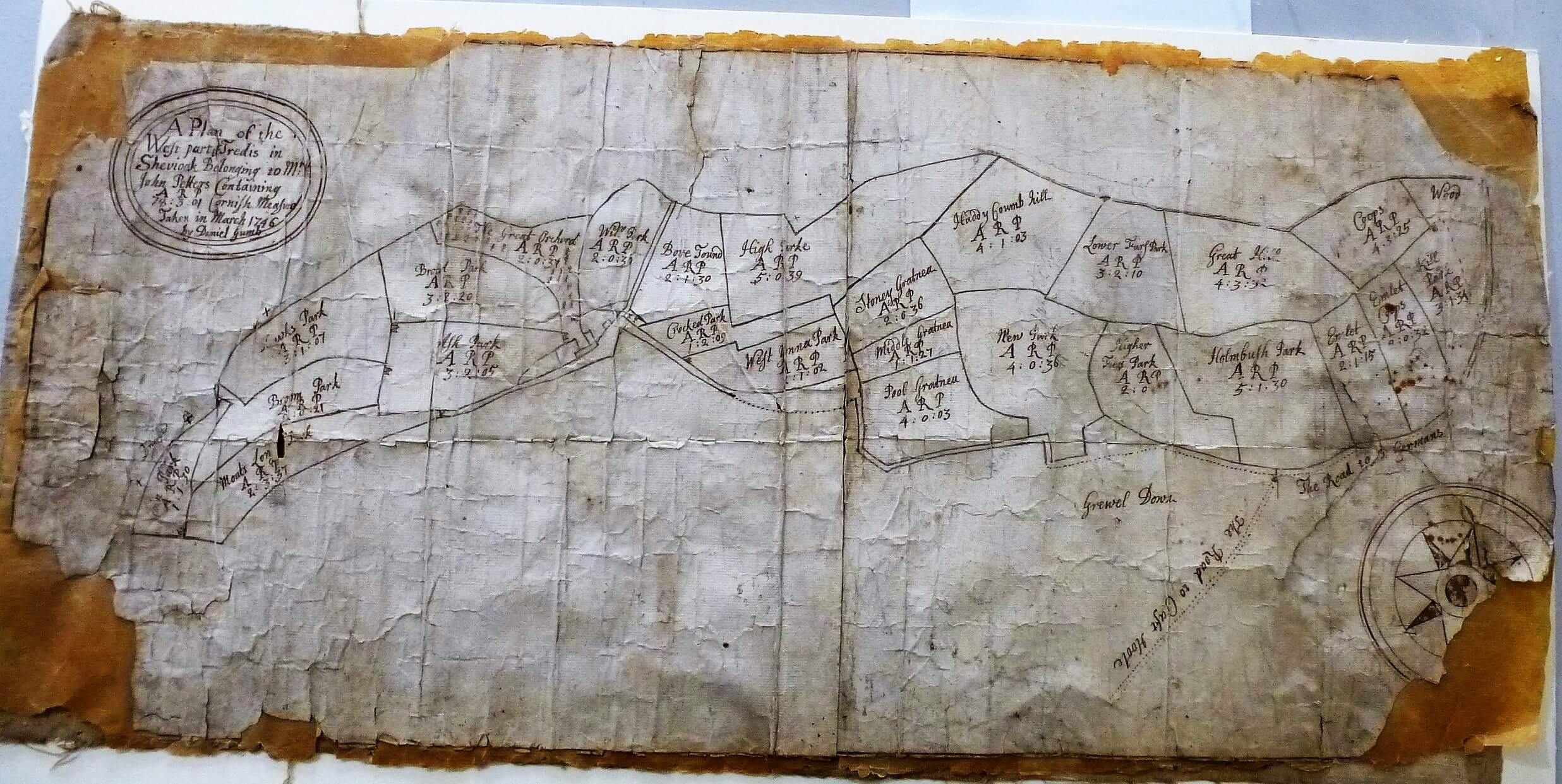
Physical Evidence: Daniel’s surviving estate maps reveal skill in both measurement and artistry. There’s physical evidence of five maps he created, with the earliest known being the Trevagera Estate Map in 1743, followed by Tredis in 1746, Coldrenick in 1756, and Trelaske (with a Stephen Stacey) in 1761. His precision was so well-regarded he was hired to create a map to resolve a local legal dispute over grazing rights on Twelve Men’s Moor in 1763.
See images of all the amazing maps Daniel Gumb created.
Beliefs and Community Ties
Despite his eccentric residence, Daniel was not an outcast and remained engaged with the community.
Philosophical Alignment: The ideas of the Enlightenment and Rational Dissent are most likely to have appealed to him, aligning with his self-taught, reason-focused philosophy.
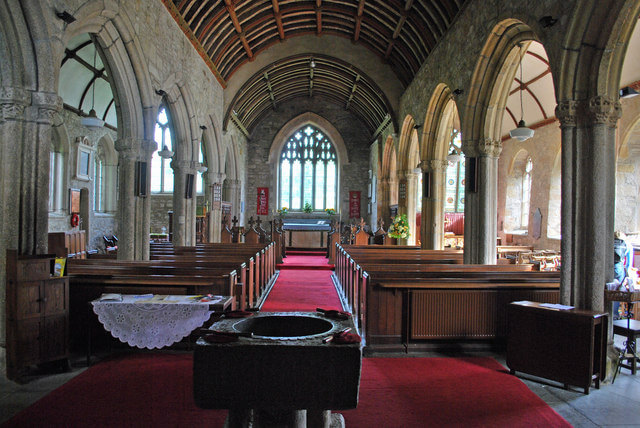
Community Ties: All of Daniel Gumb’s children were officially baptised in Linkinhorne church and he also maintained professional contracts with the Church for at least eight years, presumably for maintenance and repairs.
This is what the inside of the Church looks like today.
Daniel also maintained social ties with the community, witnessing Wills in 1736 and 1740, showing the community respected his skills even if they questioned his choice of home.
The China Clay Mystery: Daniel was a contemporary of William Cookworthy, the Quaker pharmacist who discovered how to make true porcelain in Cornwall, and it’s believed that they met at least once. Given Daniel’s mastery of surveying, mathematics, and local granite, the question remains: Did Daniel contribute any local geological knowledge to Cookworthy’s famous discovery?
Legacy and Impact
Lasting Influence: Daniel Gumb’s story has inspired historians, writers, and researchers for centuries. His cave remains a site of historical interest, and the gravestone he carved continues to draw visitors intrigued by his defiant spirit.
Modern Relevance: In an age of high rents, environmental concerns, and the pursuit of work-life balance, Daniel’s choices feel remarkably contemporary. He was the original “tiny house” advocate, environmentalist, and work-from-home pioneer – just 300 years ahead of his time.
Generations of Stonework: The family trade continued strong. In 1809 – over 30 years after Daniel’s death – John Gumb (either Daniel’s son or grandson) was paid for supplying granite kerb stones in Liskeard. This demonstrates that Daniel’s skills and trade were successfully passed down, creating a family tradition of quality stonework that endured long after his death.
The Rebel’s Enduring Appeal: Daniel proved that thinking differently and living authentically could create a life of meaning, even in the face of tremendous personal loss and social constraints. His legacy isn’t just in the stones he carved, but in the example he set of living life on one’s own terms.
Victorian Fame: Years after his death, Daniel’s remarkable story reached national attention when he was featured in Charles Dickens’ famous periodical All the Year Round in 1866 and 1869. While Dickens himself likely didn’t write these pieces, their publication in his magazine meant Daniel’s story of rebellion and self-education was being shared with readers across Britain – exactly the kind of eccentric, principled character Dickens celebrated. These articles appeared just as Daniel’s cave faced destruction from quarrying, showing how his legacy was being preserved in print even as his physical home was threatened. The Victorian public’s fascination with Daniel Gumb had begun, as demonstrated by this photo of Victorian daytrippers at the Cheesewring.